


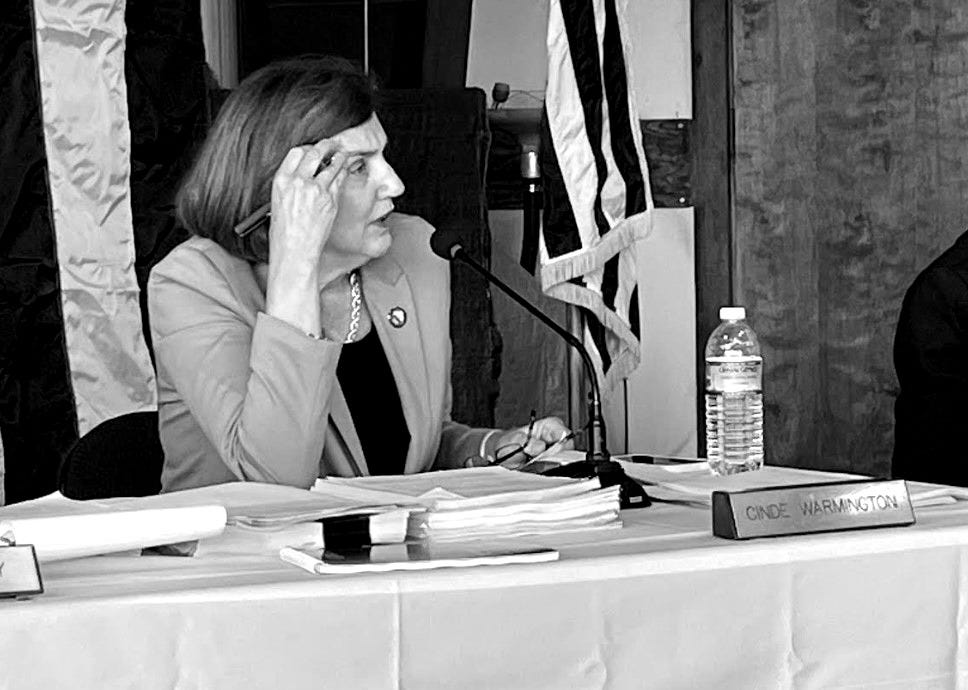
CONCORD, N.H. — Two decades before launching her bid to succeed Gov. Kelly Ayotte, Cinde Warmington was a paid lobbyist for Purdue Pharma, working to defeat New Hampshire legislation that would have restricted access to OxyContin years before the drugmaker admitted to a scheme that fueled the deadliest drug epidemic in U.S. history.
Warmington, a former Executive Councilor who filed her candidacy on June 4 and is the all-but-certain Democratic nominee against Ayotte, was hired by Purdue in late 2001 and 2002 to fight House Bill 1218, a measure that would have required patients to try three alternative therapies before being prescribed OxyContin or its generics.
At an April 9, 2002, hearing before the state Senate Committee on Executive Departments and Administration, Warmington testified that OxyContin “is a miracle drug” for many patients and had “very few side effects,” according to official hearing minutes. She argued the bill would restrict access to medically necessary medications without clinical support. Pressed by a state senator on the drug’s abuse potential, Warmington acknowledged OxyContin “is a drug of abuse as are all narcotics” and said it was “an issue that is of great concern to Purdue Pharmaceuticals.”
The state Senate voted 23-0 in favor of the restriction anyway, and HB 1218 became law later that year.
Purdue would go on to plead guilty to federal crimes twice — first in 2007, when the company and three executives admitted to falsely marketing OxyContin as less addictive and less subject to abuse than competing painkillers, paying $634.5 million, and again in 2020, when it admitted to defrauding the DEA and paying kickbacks to doctors as part of an $8.3 billion resolution. A $7.4 billion settlement between Purdue, the Sackler family and state governments was approved by a federal bankruptcy judge in November, with New Hampshire set to receive nearly $29.6 million over 10 years.
Purdue “is widely blamed for the opioid crisis that killed an estimated 645,000 nationwide,” the New Hampshire Bulletin reported. Most of the settlement funds are earmarked for governments fighting a crisis linked to 900,000 deaths since 1999, according to the Associated Press.
Warmington has acknowledged the Purdue work. A spokesman for her 2023 campaign said that she did lobbying work for Purdue in 2001 and 2002 but no other pharmaceutical company, adding that “we were all unaware of Purdue Pharma’s fraud” at the time.
But Warmington later did legal work as attorney for PainCare, a New Hampshire pain-management clinic network.
PainCare was owned by Dr. Michael O’Connell, who in 2012 agreed to surrender his medical license amid allegations that he had inappropriate romantic relationships with patients, under a settlement in which he admitted no wrongdoing. Warmington represented O’Connell in that disciplinary proceeding and helped negotiate the resolution. Two years later, in 2014, O’Connell was indicted on two felony counts of witness tampering, accused of pressuring his accusers to retract their complaints to the state medical board; prosecutors dropped the charges before trial, and O’Connell was represented in that criminal matter by Warmington’s husband, attorney Bill Christie. Warmington separately represented Dr. Anton Heins, another PainCare physician.
It was during this same period, in 2013 and 2014, that PainCare physician assistant Christopher Clough, one of the most prolific prescribers of opioids to New Hampshire Medicaid patients, was taking kickbacks from opioid manufacturer Insys Therapeutics in exchange for prescribing its fentanyl spray, Subsys. Federal prosecutors said Clough received more than $49,000 from Insys and wrote more than 750 prescriptions, including over 215 for Medicare patients, while being paid roughly $1,000 per speaking event for the company. He was convicted in December 2018 and sentenced to 48 months in prison. Warmington was PainCare’s lawyer at the time of that conduct, though prosecutors did not implicate her in it, and her documented involvement in the matter was limited to representing Clough’s supervising physician, not Clough himself.
In 2015, separately, Warmington lobbied against a bill that would have barred doctors with revoked or suspended medical licenses from owning a health care practice; the bill failed. She also met with New Hampshire Public Radio at the time to defend PainCare’s public image.
In 2023 Warmington claimed to have cut ties with the embattled opioid pushers in 2020. But an unearthed document showed that she was the registered business agent for Pinewood Professionals, a PainCare affiliate at the same address tied to PMC Medical Group in 2022.
PMC operated facilities including Granite State Pain Associates. Critics have labeled GSPA a “pill mill” for the volume of opioid painkillers it prescribed in the early 2000s.
O’Connell and PMC Medical Group went on to become significant donors to Warmington’s political career. She received a combined $49,000 in campaign contributions from O’Connell and PMC Medical Group across her two Executive Council campaigns and her current run for governor, according to campaign finance records. Warmington’s 2024 primary opponent, former Manchester Mayor Joyce Craig, put the figure at close to $70,000 from “these bad actors” during a debate that August.
The New Hampshire general election is Nov. 3.